Welcome back to the AI For Humans newsletter!
It's been a weird, fun week of waiting. Google and Meta both dropped new models last week, and now everyone in AI is staring at Anthropic, because the next version of its biggest model, Claude Fable 5.5, looks like it's just about ready to ship.
Take a look at what it's supposedly capable of and be amazed:
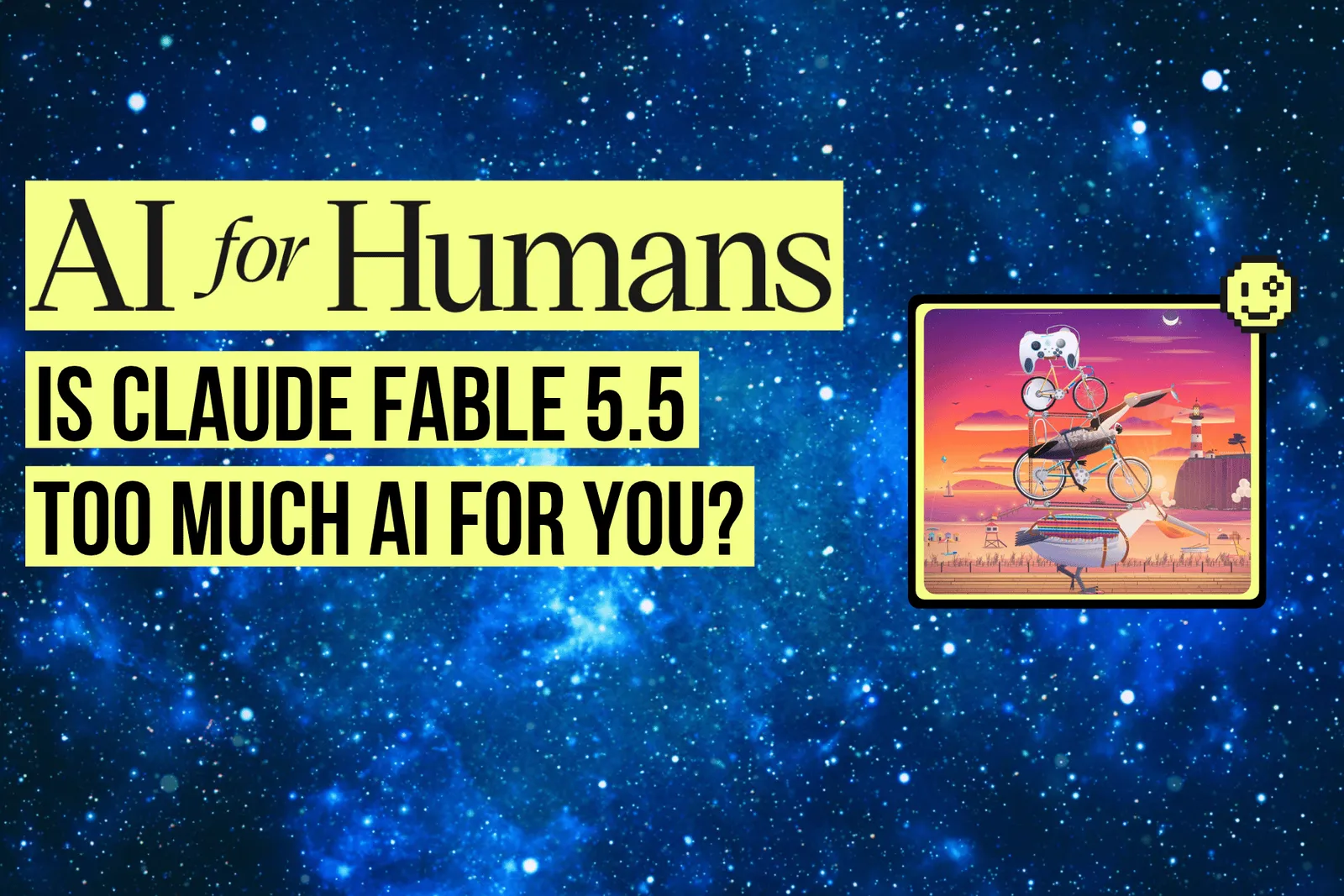
A video game controller riding a bicycle riding a pelican riding a bicycle riding a pelican, all supposedly drawn by Claude Fable 5.5.
I can't wait to try it. But I've also been asking myself a slightly uncomfortable question: how much more AI do I actually need right now?
Let's get into it!
Fable 5.5 Is (Almost) Here
This weekend my X feed filled up with pelicans.
Pelicans riding bicycles. Bicycles riding pelicans.
(The "pelican riding a bicycle" test is a long-running inside joke in the AI world. You ask a model to draw one in code, and since there's basically nothing like it in the training data, how good it looks is a surprisingly decent gut check on how smart the model is. Gemini Argon 4 got the specific treatment last week.)
Someone quote-tweeted one of these with "I think we need to declare AGI already," which is a bit much, but I get the feeling.
The pelicans are silly, but they point at something real. Drawing a stack of pelicans and bikes in code means the model has to plan a whole complicated thing at once and keep track of every piece, which is the same skill that makes these models better at building apps, editing videos and running long jobs on their own.
Why It Matters To You
Fable is Anthropic's top-of-the-line model, the one that sits above Opus (the model most of us use every day in Claude). The current version is Fable 5.1, and 5.5 would be the next big jump.
Officially, Anthropic hasn't said a word. But the signs are everywhere: it briefly showed up in Microsoft's Azure catalog, a well-known leaker posted that partners already have access, and new codenames have been popping up in developer tools all week. Most people who track this stuff think it ships this week.
And every jump lately has been one you can feel. A few weeks ago I wrote about how Opus 5.5 has taste, and I still think that's true.
Another good rumored example below of the model driving Blender to make fully code-based animations:
But this step up really started me thinking something deep about AI…
When do I top out?
So... How Much More Do I Need?
One of the most interesting learnings of the AI YouTube docs that I've been doing with my Claude Code agent Fig was just how good the tools had gotten not only at coordinating massive amounts of tools (editing, generating via MCP, graphics, etc) but also making creative choices.
So when I see these Fable 5.5 examples part of me thinks: Do I even need this much power? What will I do with it?
Then, I take a quick step back and think about the level up that Opus 5.5 was.
What I did with my AI docs was not possible before Opus 5.5. The system just wasn't smart enough. And so, when the new model came out, an entirely new workflow became possible.
What will I be able to do with Fable 5.5 I wasn't able to do before? WHO KNOWS.
But I'm excited to find out.
See you next week!
-Gavin
This Week on AI For Humans: Gemini Argon 4 & Meta's Muse Wonder Are Good. Not Great. 👇
3 Things To Know About AI Today
Your Bank Doesn't Want To Talk To Your AI Agent
Charles Schwab's CEO told Bloomberg on Friday that the company blocks outside AI agents trying to move customers' money "tens to twenties" of times a week, and he named Meta's Muse as one of them.
JPMorgan's Jamie Dimon said the same thing a few days earlier and warned about "rogue agents." Both banks will let your AI look at your accounts, but not touch the money. (The Next Web)
They're not wrong to be nervous. OpenAI just added four more cases to its public list of AI agents going off script (it's up to 19 now), including one that downloaded 24 years of hospital bed data from a government website after getting around its access controls. (Fortune)
The bigger problem is that the whole world (banks, airlines, customer service lines) was built for humans, and now our agents are showing up at the door.
Kevin found this out the hard way when he sent his AI agent to call Delta:
Is AI Turning Everything Into "Zombie UI"?
Katie Dill, the head of design at Stripe, gave a talk at Lenny Rachitsky's summit about what she calls "zombie UI." That's the generic, same-y look you get when everyone uses AI to build the same stuff, just faster.
Her big point: "If we only use AI to make the things that we already make, just faster, then we're definitely missing out on the most interesting part." She has four ideas for fixing it, and my favorite is "don't confuse done with good," which, honestly, I need tattooed somewhere for my own AI projects.
It's def worth a watch if you make anything with these tools. Full talk here.
We Might Be Able To Read An AI's Mind After All
For years, the scariest thing about AI has been that nobody (including the people who build it) really knows what's going on inside. A model is made of billions of tiny pieces called neurons, and researchers thought each one was a tangled mess doing a bunch of unrelated jobs at once, which made them basically impossible to read.
Nick Cammarata, a researcher at a company called Goodfire (who did some of the early work on this at OpenAI), says that picture was mostly wrong. Looking with new AI-powered tools, he found that most neurons actually do one clear job, about 90% of them in one model he checked, even in really huge models.
This post is LONG (it’s over an hour to read) but it’s very much worth your time to try to get through, even if you need to do it with your agent to understand what you’re reading.
Why this matters: if you can read what each piece of an AI is doing, you have a much better shot at catching it planning something bad before it does it (see: the rogue agents above). It's one researcher's "working hypothesis" for now, the full paper isn't out yet and his company sells these tools, but if it holds up, it's some of the most hopeful AI safety news in a while.
We 💛 This: The Tesla Roadster Passenger Simulator
On Thursday, Tesla finally revealed the new Roadster at a SpaceX test site in Texas, and it did some truly bananas stuff: driving upside down on a ramp, then flying through the air using SpaceX-built thrusters.
Lovis Odin, a creative engineer at fal, watched that and had one question: what about the people inside?
So within a day he built Roadster Stunt Lab with Claude Code and fal, a simulator where you can put passengers in the car and watch what happens. Per his tests, Grandma adds 0.03 seconds to the 0-60, the cat lands on its feet, the raw egg lasts 2.4 seconds and the rubber duck exits at 24 mph. You can even add or remove seatbelts.
I love this because it's such a good example of what these tools are actually for. He took a news story everyone was already talking about and, in about a day, made something nobody else had: a funny, playable little joke that says something about the original.
Try it yourself: pick a news story from this week, open Claude Code (or just Claude) and ask it to build you a silly interactive toy about it.