After a week off, there's a ton of news to get to, including the surprising math breakthroughs from OpenAI's unreleased Astra model.
But first, there's a MUCH bigger deal that everyone needs to understand:
AIs are REALLY good at using your computer now.
I had a remarkable experience with ChatGPT's improved Computer Use feature last week, and I'm here to tell you these little AIs can now do the most frustrating, boring stuff for you. And do it well.
Let's get into it.
What Exactly IS Computer Use?
Computer use is exactly what it sounds like: the AI takes over your mouse and keyboard. It looks at your screen, clicks buttons, types into forms, and moves files around.
If you tried this a year ago, you know it sucked. It was SO bad.
The early agents were slow, got lost constantly, and asked permission every ten seconds.
Even Atlas, OpenAI's standalone AI browser, never quite landed. It's now being sunset, with its brain folded into the new ChatGPT desktop app.
So why would you want this?
Because a ton of what we do daily is interacting with the open web (email, spreadsheets, shared docs) or local files on our computers. Computer use lets AI connect those dots and get stuff done that actually matters.
And again, this used to be a frustrating experience. But it WORKS now.
How To Use It (For Humans)
The best experience I've had is in the new ChatGPT app (which used to be the Codex app) on my MacBook. There's a Windows version too, and for now we'll consider them the same. Your mileage may vary.
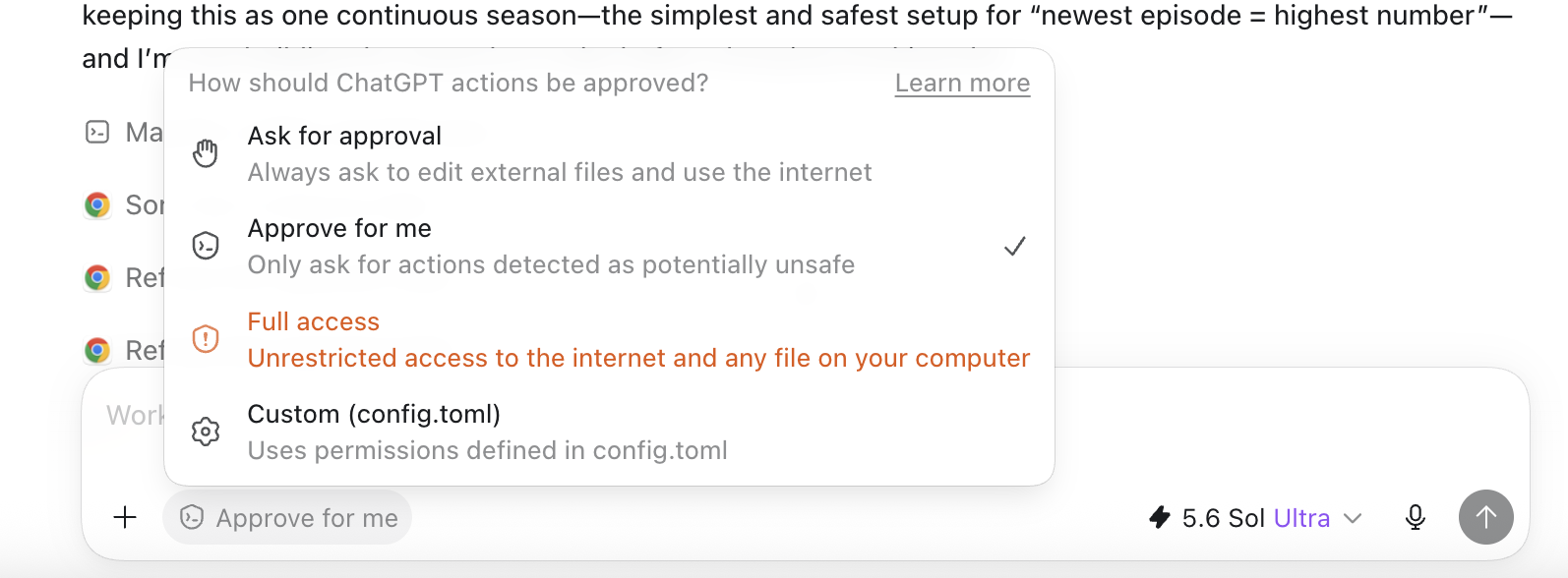
Install it, then give it whatever permissions you're comfortable with. You can adjust these in the chatbox itself. Myself, I'm kind of crazy and give it all the permissions. Most security-minded people would NEVER do this, but it does make everything much faster.
Please use the permissions at first as it will step you through the processes.
Next, the biggest and most important step, come up with something you'd like it to do.
Here's mine from last week:
YouTube recently let recurring series turn themselves into "shows," basically a stream designed for TV screens. I went to import all the episodes of AI For Humans and it scrambled the entire order of the series.
That's a big deal because you want the most recent episode first (not many people need the November 2024 episode unless you're a Midjourney 5 completist).
And YouTube makes fixing this TEDIOUS. You have to tweak each episode and save it individually.
So I opened the ChatGPT app and asked this:
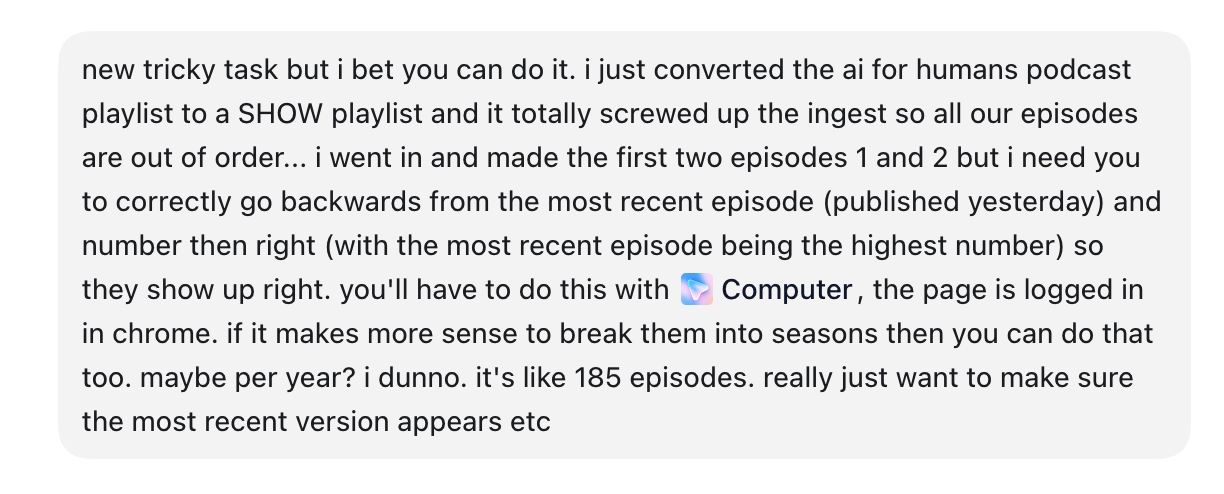
The important things here: tagging @ computer use (which invokes the skill) and having the ChatGPT Chrome extension installed. Then, it's just answering a few questions and letting the machine work.
And work it did. I know this sounds stupidly simple, but it did exactly the job I needed and gave me three hours of my life back.
You can now see AI For Humans' show page here.
Now, would I trust it with something I couldn't easily redo?
NO. NOT ON YOUR LIFE. At least not yet.
But this is how AI is supposed to work, and now it's working.
AI Is FINALLY Doing Stuff We Need
For two-plus years we've been promised AI that actually does things for us, and mostly we've had annoying things that say "sure" and then fail miserably.
This moment does feel different to me. The boring, fiddly, twenty-clicks-deep tasks (renaming files, updating spreadsheets, fixing settings one at a time) are exactly where these agents are getting good.
Start small: point one at something annoying and reversible. Have it unsubscribe you from fifty newsletters. It does GREAT with Gmail.
Or clean up your downloads folder. Whatever. Little stuff. I promise you'll be impressed.
3 Things To Know About AI Today
Seedance 2.5 Lands, But Not For The United States
In a rare non-US-first launch, ByteDance's Seedance 2.5 is now live in many parts of the world via Dreamina and the Volcano Engine API, with no confirmed American date thanks in part to the copyright fights that slowed Seedance 2.0's US rollout.
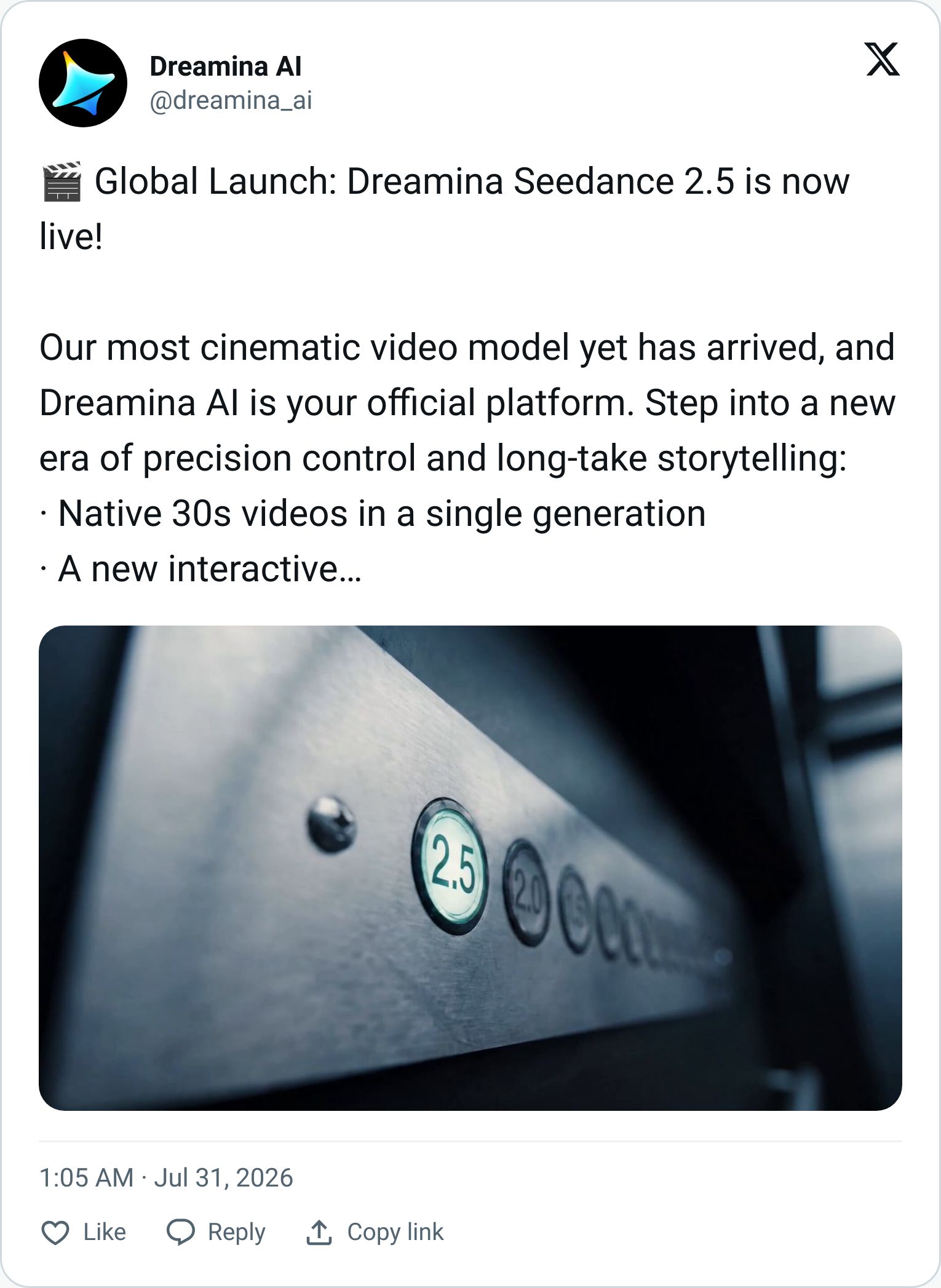
What we've seen so far: native 30-second generations (no stitching), up to 50 reference inputs (images, video, audio, even 3D models), native 4K, and subject-swapping after generation.
WHY THIS MATTERS: The best AI video model in the world might not be available in America for a bit. That's a first.
OpenAI Announces Ten More Solved Math & Computer Science Problems
While there's a ton of debate about whether we're in an AI economic bubble, the AI capability bubble narrative has been popped.
AI is getting smarter. That's all. Like, endlessly.
This weekend, OpenAI announced that an internal version of Astra, their next major model (which WILL be coming to all of us), solved ten previously unsolved problems in math and theoretical computer science: sphere packing, Ramsey numbers, lattice cryptography, and more.
If none of that makes sense to you, join the club. But it's a major deal.
People love to argue that pure math doesn't matter much to the real world, but it IS the language of the natural world.
Total compute cost? About $2,000.
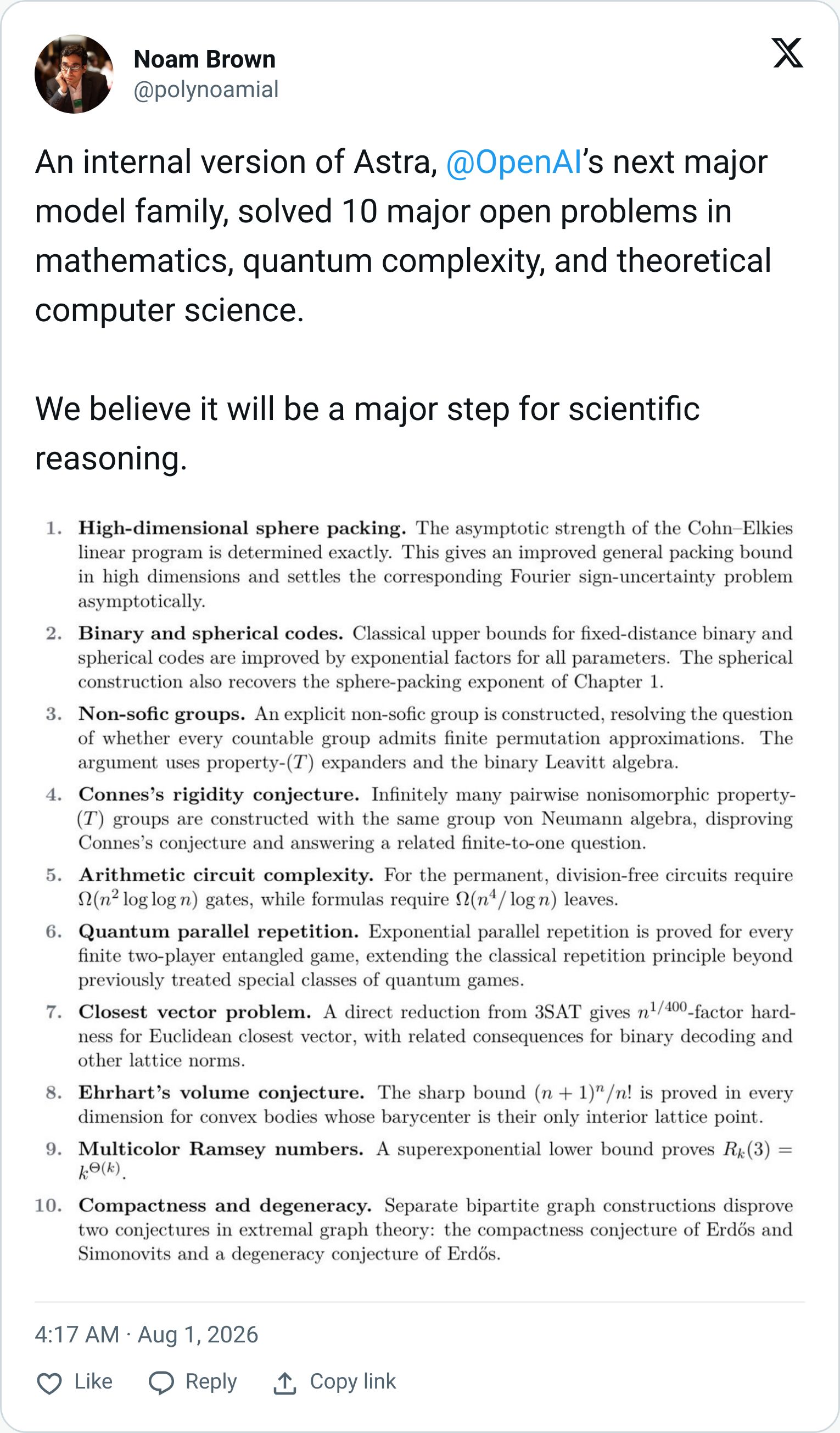
WHY THIS MATTERS: It's not curing cancer but it might be the first step toward curing cancer and a whole lot of other scientific advances.
Hank Green's Odd AI "Controversy" & The Response
One of my all-time favorite YouTubers is Hank Green, who, along with his brother John, has been YouTubing forever and is very good at it.
He's been a pretty vocal voice against AI, yet lately he'd started talking about AI coding in the sort of smart, measured way we need more people to bring to this subject.
Then viewers caught the phrase "I appreciate the pushback" in a recent video, a ChatGPT response accidentally left in his script. The knives came out FAST. Green owned it: he says he used ChatGPT for research and finding sources, not for writing.
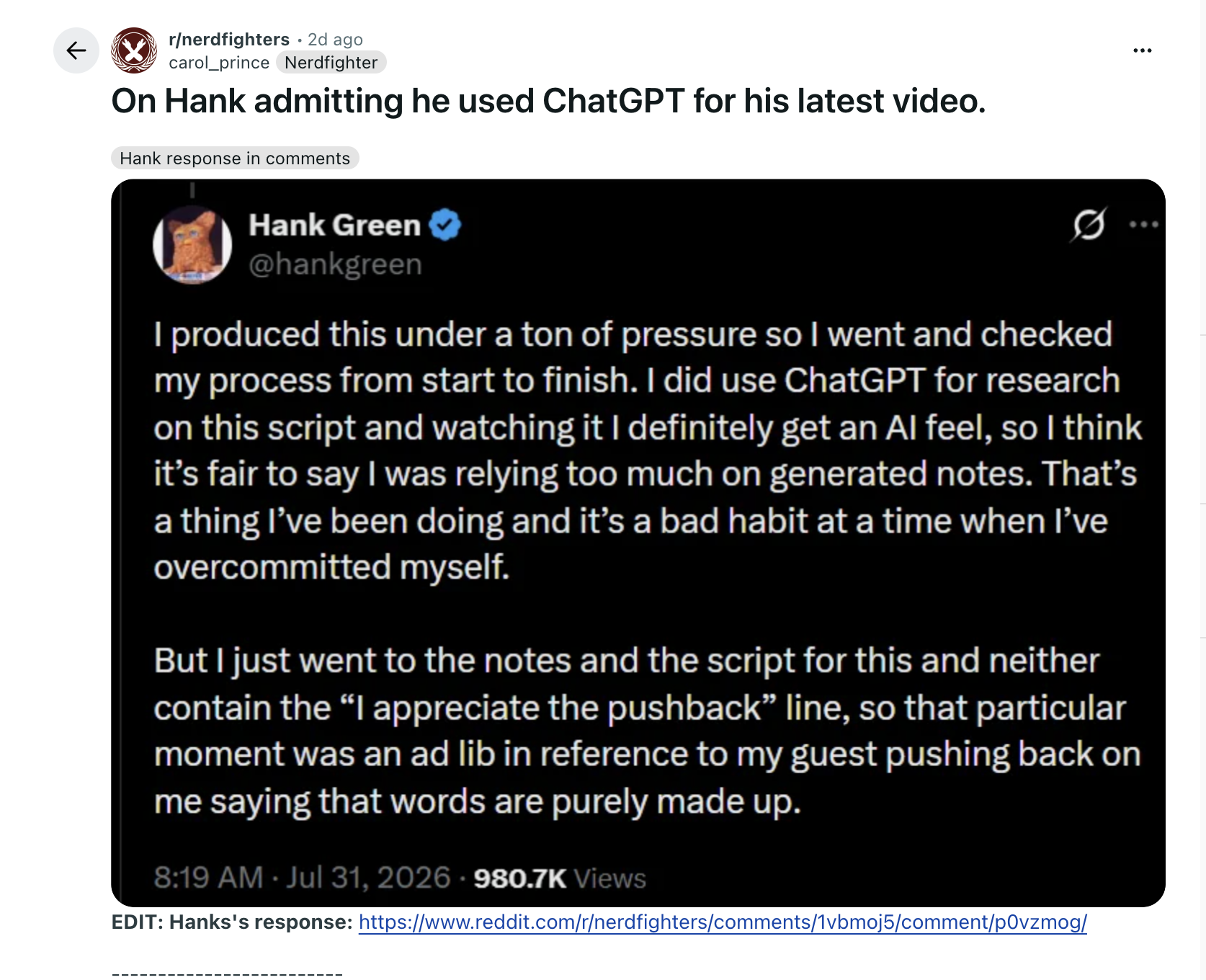
In a long apology on Reddit he admitted the dopamine he gets from talking to LLMs is "not healthy for me or good for the world," and he's slowing his video output for a while.
WHY THIS MATTERS: Using a chatbot for research is probably the most defensible AI use there is, and that was enough to trigger a fan revolt. Not my favorite moment of the AI debate.
Andrej Karpathy's Claude Code Lord Of The Rings
The patron saint of the AI For Humans newsletter is back.
Andrej Karpathy, the famed AI researcher who joined Anthropic back in May, started experimenting with Claude "production" much in the same way I've been working with Fig and Moss.
He gave Claude Opus 5 ten bucks worth of tokens and the first paragraph of Lord of the Rings, then asked it to build the scene as an interactive Three.js world.
Two hours and roughly 5,500 lines of code later, it had placed the assets, written the animations, and built a small explorable 3D world.
Karpathy called it "kind of janky but fun," which is fair. But project out a little bit farther, and you can see how this becomes something much bigger.
To him, it's a new way to test LLM capability ("LLMs have all the stamina and patience in the world," he wrote). To me? It's a chance to give Fig and Moss another thing to watch and react to.